


Generative AI & Medicine
JUNE 28 - JULY 9, 2027 (no class on July 5)
As AI technologies integrate and permeate our everyday lives, we become aware of how they impact our lives and the biases inherent in these systems. This class will introduce - investigating how AI design can integrate or incorporate human, societal, environmental, health, and economic needs.
Download brochure here.
Application coming soon: Nov 25, 2026.
Course Leads: Dr. Vishnu Ravi, Reza Habibi, PhD
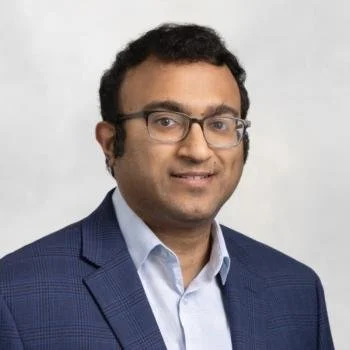

Dr. Vishnu Ravi combines his expertise as a board-certified, practicing internal medicine physician, senior software engineer, and board-certified clinical informaticist to create transformative solutions for healthcare.
As the Technology Architect for Stanford Medicine Catalyst, the Stanford School of Medicine's flagship innovation program, he designs, develops, and implements innovations including AI-driven platforms for Parkinson's care, chronic cardiovascular disease management, and precision pharmacogenomics that are helping patients receive more personalized and effective care.
At the Stanford Mussallem Center for Biodesign, Vishnu helps lead the center's digital health initiatives spanning education, research, and translation. To support this work, he co-founded Stanford Spezi, an open-source framework and ecosystem for building modular, standards-based digital health solutions that is now used by leading healthcare institutions and companies worldwide.
Reza Habibi is a researcher and instructor at UC Santa Cruz and Stanford University whose work explores how AI systems can understand, learn from, and collaborate with humans. He is completing his PhD on human-AI collaboration and co-creation, drawing on interpretability, symbolic interaction, and reasoning to make generative AI more accessible and meaningful for learners and educators. His research spans human-centered AI, mixed and augmented reality, and interactive systems, including projects that visualize complex human behavior models, use AI and immersive technologies for learning, and support resilience among first-year students through participatory design. Alongside his academic work, he teaches courses in Human-Centered AI at UC Santa Cruz and Stanford, as well as Interactive Game Design, Mixed Reality, and Generative AI at Stanford. Reza is also involved in motorsports as both a driver and engineer for years.
